The $3,000 Machine vs the $100,000 Machine
Both call it "laser hair removal"
The Reality
Your clinic says they use "advanced laser technology." It could be a $100,000 Candela GentleMax Pro. It could be a $3,000 import from Alibaba. Both statements are technically true. The difference is in what you can't see, and what your clinic probably won't tell you.
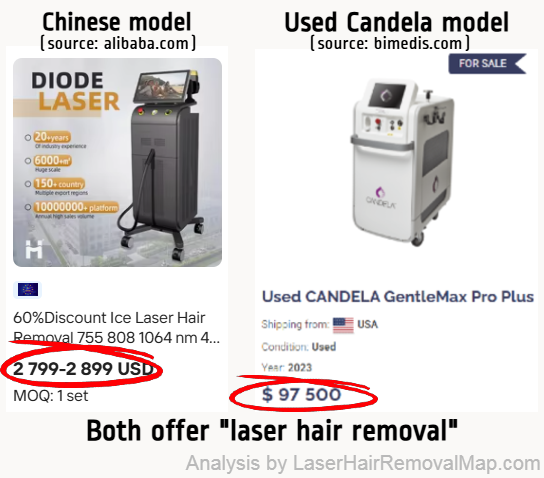
What Laser Hair Removal Machines Actually Cost
Most consumers assume all "laser hair removal" uses similar equipment. The price range across machines tells a different story.
Here are the price ranges for cheap Chinese brands you can find on Alibaba:
Compare that to what established manufacturers charge:
What the Money Buys
Power output and consistency
Premium machines deliver higher, more consistent energy per pulse. A cheap machine might advertise the same peak power but can't sustain it across a full treatment session. The result: some follicles get enough energy to be destroyed, others don't. That's why you come back for more sessions.
Cooling systems
Candela's Dynamic Cooling Device (DCD) sprays cryogen milliseconds before each pulse, precisely timed to protect your skin while the laser reaches the follicle. Budget machines use basic contact cooling or nothing at all. Better cooling means higher safe energy levels and less pain.
Spot size and treatment speed
Premium machines offer larger spot sizes (up to 24mm) for faster coverage. A LightSheer Duet can treat a full back in under 15 minutes. A budget machine with a small handpiece could take over an hour for the same area and miss spots.
FDA clearance vs CE marking
Most premium devices hold FDA 510(k) clearance, which requires clinical evidence of safety and efficacy. Many imports carry only a CE mark, which in some cases is a self-declared conformity mark, not an independent safety review.
Calibration and manufacturer support
Premium manufacturers provide ongoing calibration, software updates, and certified service technicians. When a budget machine drifts out of calibration, there's no manufacturer to call. The clinic may not even know it's delivering inconsistent energy.
Practitioner training
Candela, Lumenis, and Cynosure provide clinical training with their machines. Budget importers ship a device and a manual. The operator's skill matters as much as the equipment and training is part of what that $100,000 buys.
The Combo Machine Red Flag
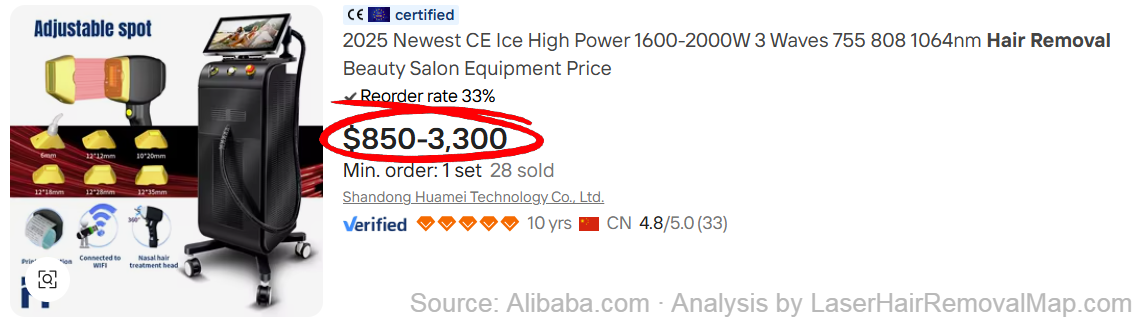
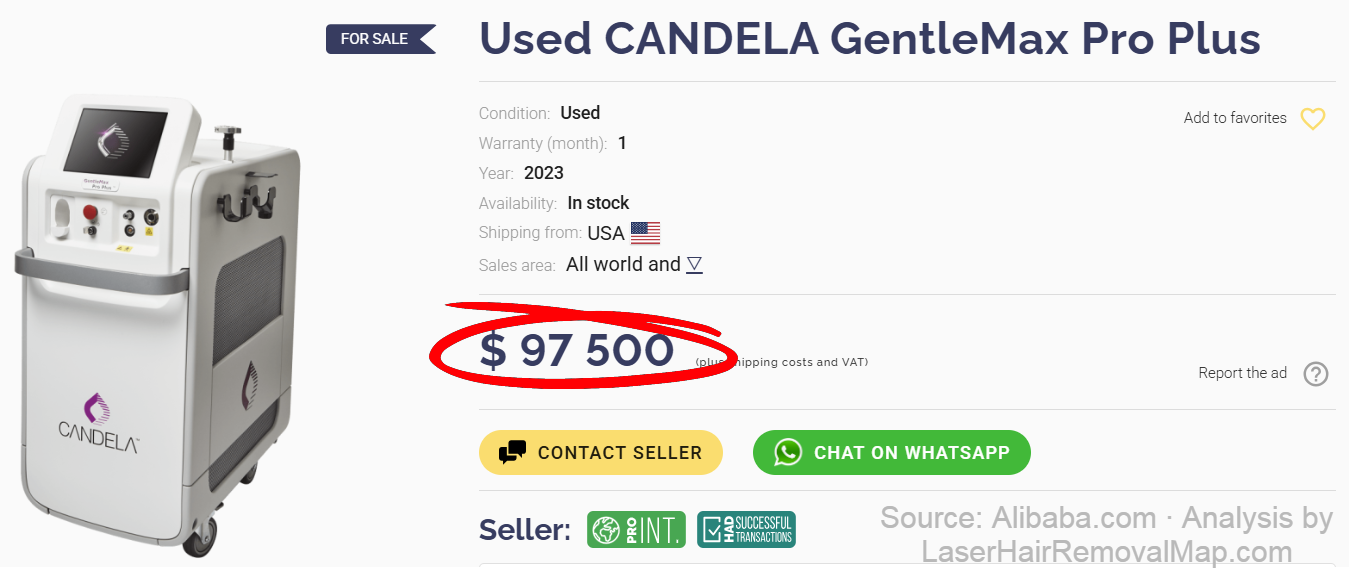
The combo machines are the biggest red flag. A machine starting at $850 claims three wavelengths (755nm + 808nm + 1064nm). The $97,500 Candela has two. When a machine costing less than 1% of the price claims to do more, that tells you everything. A clinic can truthfully say "we use all three wavelengths" while using a machine that costs less than a month's rent with their own brand printed on it.
Legitimate tri-wavelength machines exist: the Alma Soprano Titanium and InMode Triton both cost $50,000–$90,000 and come with clinical training and service contracts.
When a clinic advertises "triple wavelength laser" at prices well below competitors, the question isn't whether they have three wavelengths. It's whether those wavelengths are delivered by a machine built to clinical standards.
The White-Label Machine
This isn't just a cheap machine. It's designed to be untraceable. The manufacturer explicitly offers as standard services:
Custom logo: any brand name printed on the machine body and screen
Custom software: your own program interface, in any language
Custom colors: choose the look of the machine
Custom packaging: no trace of the original manufacturer
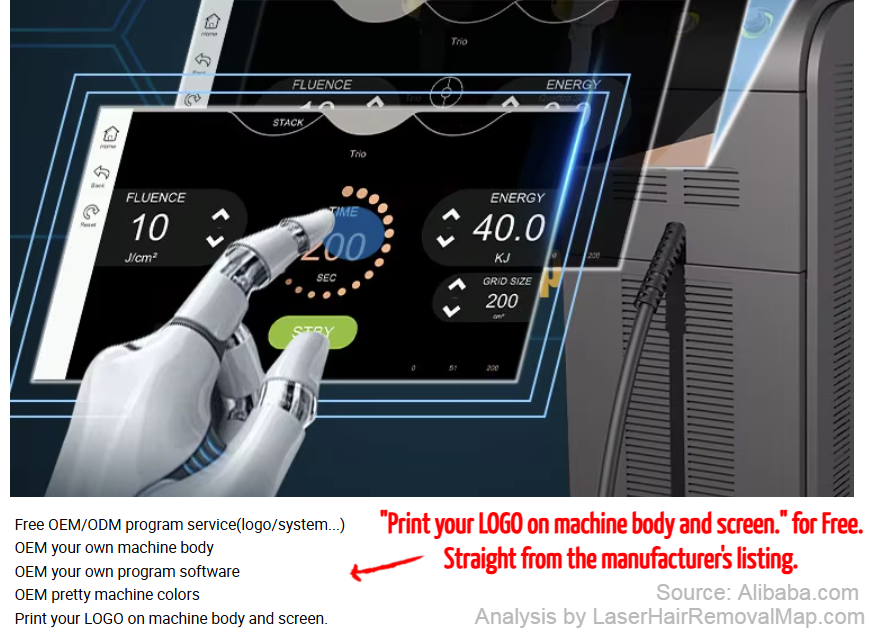
The manufacturer behind the $850 machine we found operates a 6,000m² factory with 145 staff. They already run six private label brands. They have over 3,200 store reviews and $2.3 million in annual online revenue. This isn't a back-room operation, it's industrial-scale white-labeling.
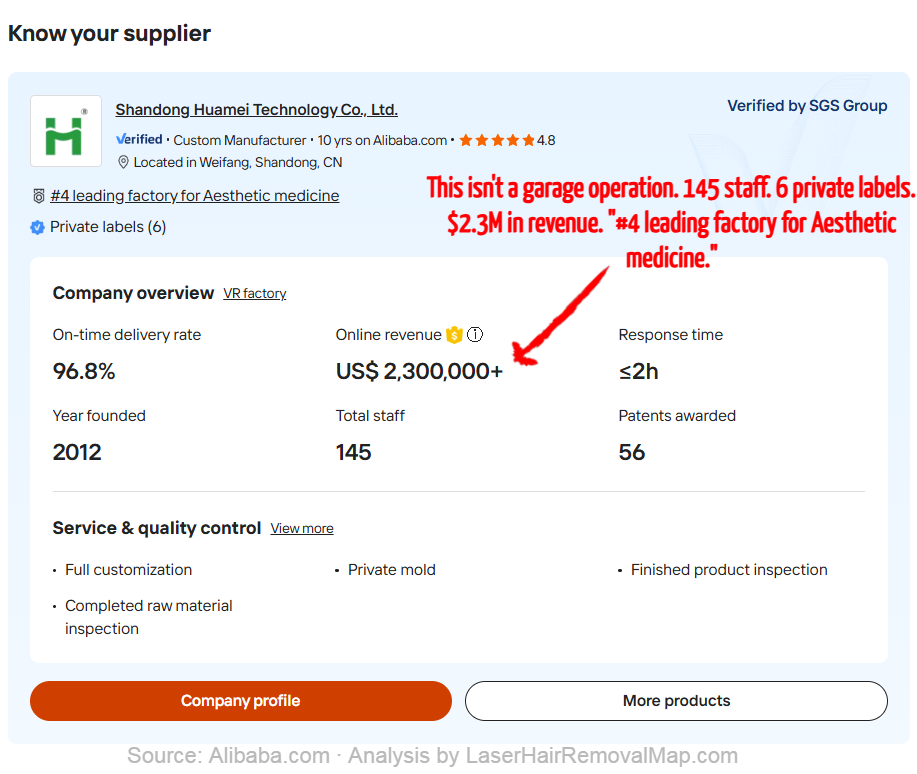
A clinic buys this machine for $850, puts their own name on it, and the patient sees what looks like a proprietary branded device. There is no way to tell from the outside. The machine even comes with a "4K touch screen" and customizable language settings. It looks professional in the treatment room.
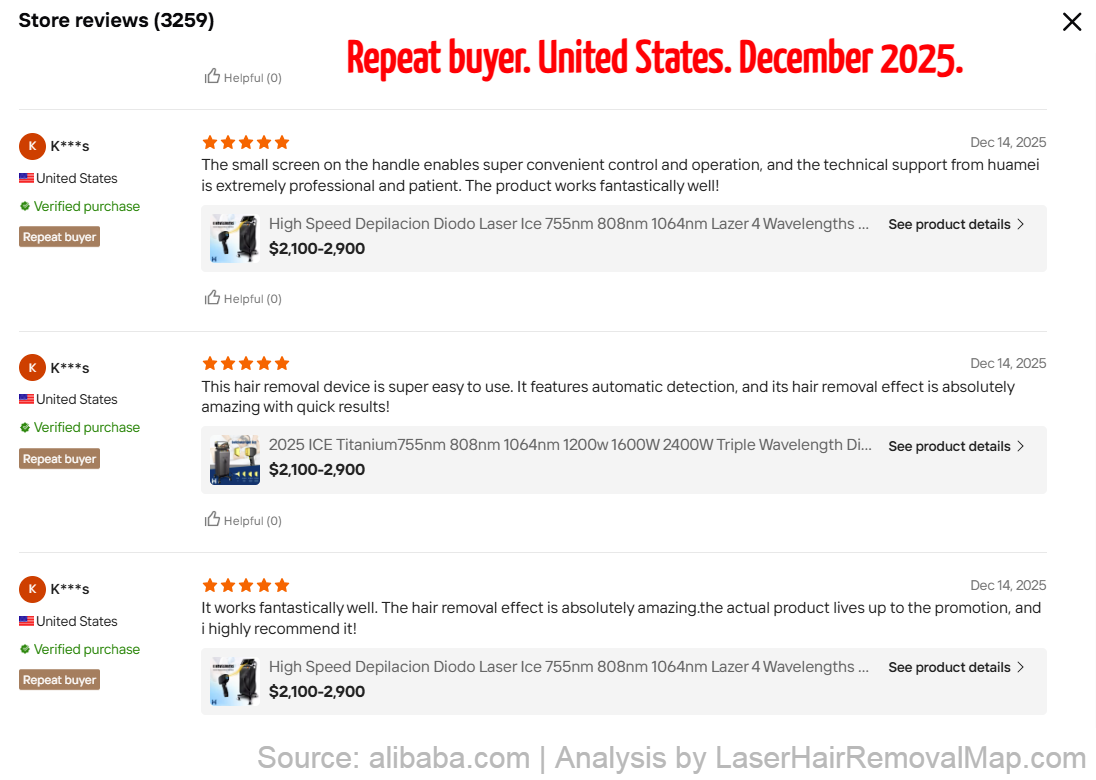
Verified reviews on the listing include repeat buyers from the United States and France, all from late 2025. These machines are actively entering clinics right now.
The "American Laser" Claim
Some of these manufacturers display test sheets from Coherent, a legitimate American laser component supplier, to suggest their machines use premium parts. The listing we found includes a magnified photo of a Coherent manufacturing test data sheet as a marketing image:
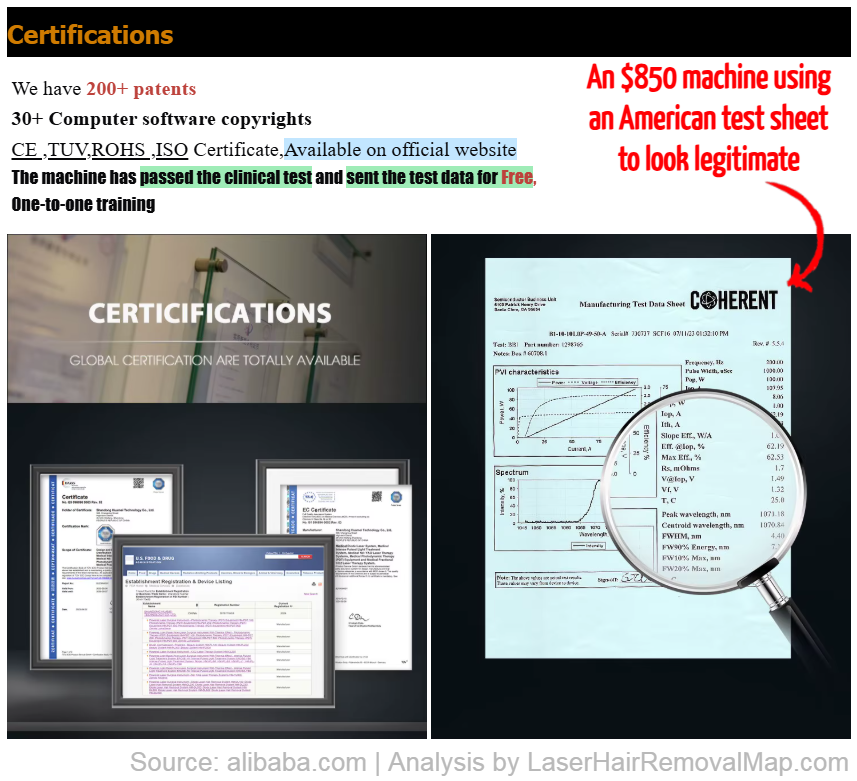
Even if the diode bar inside is genuine, it's a single component. A laser diode bar doesn't make a clinical-grade machine any more than a German engine makes a kit car a Mercedes. The power supply stability, cooling system, beam delivery, calibration software, and safety interlocks are what separate an $850 machine from a $97,500 one.
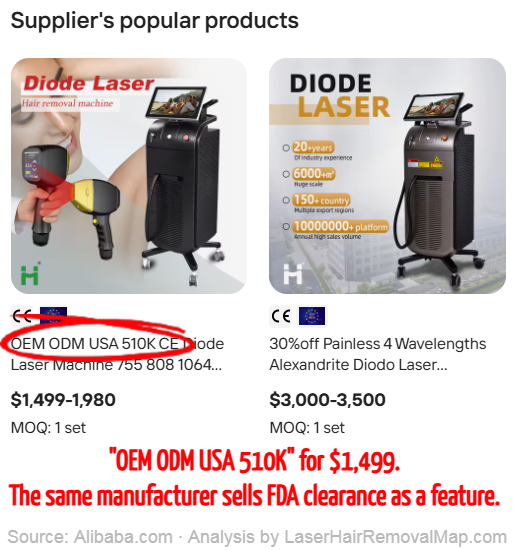
The same manufacturer also lists a version advertising "OEM ODM USA 510K CE", implying they can provide FDA 510(k) documentation for their white-label machines. Legitimate manufacturers spend years and millions of dollars obtaining FDA clearance for each device.
How to Protect Yourself
Ask your clinic directly: "What brand and model of laser do you use?"
If they name a brand you can't find anywhere online: that's a red flag. White-labeled machines are designed to be unsearchable.
If they can't or won't answer: that's a bigger red flag. Reputable clinics are proud of their equipment investment.
If they say "we use our own proprietary technology": be skeptical. Clinics don't manufacture lasers. Candela, Lumenis, Alma, and Cynosure do.
Once you have the answer, check how it's rated in our equipment database →
Know a clinic using premium equipment? Share this article: it helps them explain why quality matters.
Have information about equipment we should investigate? Get in touch.