Purpose-Built vs. Multi-Purpose Lasers
What it means for your results
The Question Nobody Asks
You asked your clinic what laser they use. They told you the brand name. Maybe they even showed you a brochure. But there's a question most people never think to ask: was this machine designed specifically for hair removal?
Not all professional lasers are. And the difference matters more than you might expect.
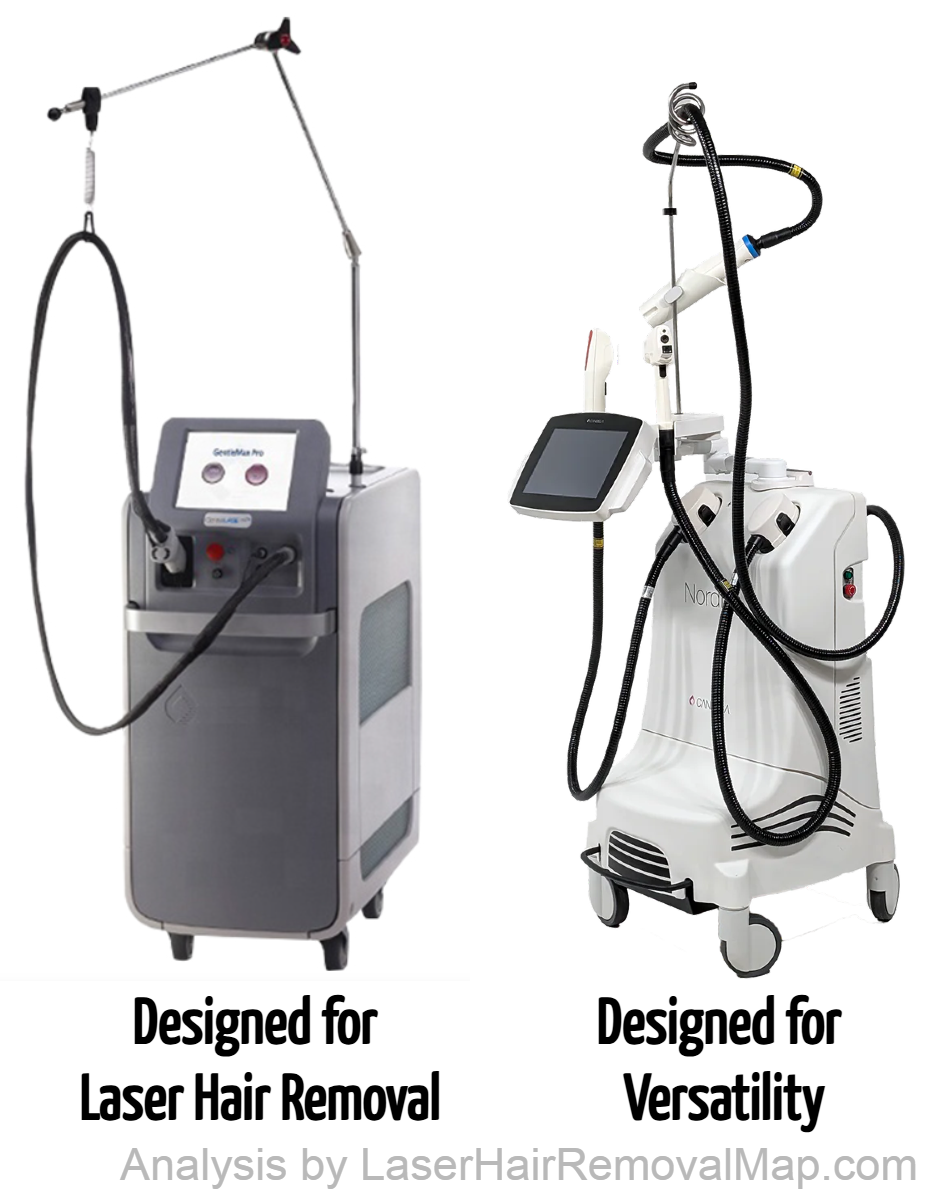
What “Purpose-Built” Actually Means
A purpose-built hair removal laser is a device where the primary engineering decisions, wavelength selection, spot sizes, cooling system, repetition rate, pulse control, were optimized for one job: destroying hair follicles.
Devices like the Alma Soprano Titanium, Lumenis LightSheer family, Cynosure Vectus, and DEKA Motus were designed around hair removal from the ground up. Every component was chosen to make that specific treatment faster, more comfortable, and more effective.
That doesn't mean they can only do hair removal. Most professional lasers are FDA-cleared for multiple indications. Even the Candela GentleMax Pro, arguably the most recognized name in laser hair removal, is also used for vascular lesions, pigmented lesions, and skin rejuvenation. The LightSheer treats skin rejuvenation. The Soprano platform handles skin treatments too.
Pure single-purpose devices are rare. When we classify a device as “purpose-built for hair removal,” we mean that hair removal was the primary design goal. The engineering trade-offs favor hair removal performance. Other capabilities exist, but they're secondary.
What “Multi-Purpose” Means
Multi-purpose platforms take the opposite approach. They were designed to be versatile, a single investment that lets a clinic offer many different treatments. Hair removal is one option among several equals.
The Candela Nordlys, for example, handles hair removal, vascular lesions, pigmented lesions, acne, rosacea, and skin rejuvenation through interchangeable handpiece modules. The Alma Harmony XL Pro offers a similar breadth. Cynosure's Icon platform, Fotona's SP Dynamis, and Aerolase's Neo Elite (cleared for 36+ indications) are all designed with versatility as the primary goal.
These are legitimate, FDA-cleared devices from established manufacturers. They work. Many clinics get good results with them for hair removal.
But the design priority is breadth, not depth.
Why the Distinction Matters for Your Results
Think of it like kitchen knives. A chef's knife is purpose-built for chopping, slicing, and dicing. A Swiss Army knife has a blade too, and it works, but nobody would choose it over a chef's knife to prepare dinner. Both cut. One was designed to cut well.
The practical differences between purpose-built and multi-purpose tend to show up in a few ways:
Treatment speed
Purpose-built devices typically have larger spot sizes and higher repetition rates optimized for covering skin quickly. A full-back treatment on a Soprano Titanium with its large applicator is meaningfully faster than the same treatment on a multi-purpose platform using a hair removal handpiece attachment.
Consistency across sessions
Purpose-built systems tend to deliver more uniform energy distribution because the beam delivery was engineered for the specific demands of hair follicle targeting. Multi-purpose platforms need to be more general in their energy delivery to accommodate different treatment types.
Cooling precision
Hair removal requires very specific cooling to protect the epidermis while the laser heats the follicle beneath it. Purpose-built systems like the LightSheer (with its vacuum-assisted compression) or the MeDioStar (with 360° Peltier cooling) have cooling systems designed specifically for the thermal profile of hair removal. Multi-purpose devices use more generalized cooling that serves multiple treatment types adequately.
Number of sessions
This is where the difference is most visible to consumers. An experienced practitioner with a purpose-built device will typically achieve satisfactory hair reduction in fewer sessions than the same practitioner using a multi-purpose platform. Fewer sessions means less time, less money, and less inconvenience.
None of this means multi-purpose devices can't remove hair effectively. They can. An experienced operator with a Nordlys or Harmony XL Pro will get results. The question is whether those results come as efficiently as they would with a device engineered specifically for the task.
Why Clinics Choose Multi-Purpose Devices
This isn't about clinics cutting corners. There are legitimate business reasons to invest in a multi-purpose platform:
A single Harmony XL Pro or Nordlys lets a clinic offer hair removal, vascular treatments, pigmentation correction, skin rejuvenation, and acne treatment, all from one device. That's five revenue streams from one purchase, one training investment, and one footprint in the treatment room.
A clinic that bought a dedicated Soprano Titanium for hair removal, a dedicated Vbeam for vascular, and a dedicated PicoWay for pigmentation would have better-optimized tools for each job, but also three devices to purchase, maintain, insure, and train staff on. Not every practice can justify that investment.
“Most [lasers] do multiple things and a lot of practices try to buy one that they can get the biggest variety of treatments from. This means that they may not be the best for laser hair removal, but if they've spent the money for that machine, they are going to use it for laser hair removal also.”
— Laser technician with 20+ years experience and 100,000+ sessions, via r/laserhairremoval
To summarize: it's a practical business decision. The question for you as a consumer is whether you understand which kind of decision shaped the equipment being used on your skin.
How We Classify Devices on This Site
On every machine page in our equipment database, you'll see whether we've classified the device as purpose-built for hair removal or multi-purpose.
Hair removal was the primary design goal. The device may have secondary capabilities, but the engineering priorities favor hair removal.
Examples:
The device was designed as a versatile platform where hair removal is one of several equal applications.
Examples:
Both categories include devices from reputable, FDA-cleared manufacturers. Both can deliver results. The distinction is about design priority, not quality.
What to Ask Your Clinic
You don't need to interrogate your provider. But if you're choosing between clinics, or if you're not seeing the results you expected, these questions can help:
“What specific device do you use for hair removal?”
A confident clinic will name the brand and model without hesitation. If they give a vague answer like “we use a medical-grade laser,” that's worth noting.
“Was it designed primarily for hair removal, or is it a multi-purpose system?”
Most clinics won't be offended by this. If they use a purpose-built device, they'll be happy to explain why. If they use a multi-purpose platform, the good ones will be upfront about that too, and explain how their expertise compensates.
“How many sessions should I expect?”
This is where the rubber meets the road. Compare the answer across clinics. If one clinic estimates 6 sessions and another estimates 10 for the same area on the same skin type, the equipment difference might be part of the reason.
The best clinics combine good equipment with experienced operators. A skilled practitioner with a multi-purpose platform can outperform a novice with a purpose-built device. But all else being equal, purpose-built matters.
For more on how equipment cost and origin affect treatment quality, see our equipment cost analysis. To verify what equipment your clinic uses, try our equipment verification tool.
Have information about equipment we should investigate? Get in touch.