IPL (Intense Pulsed Light)
Quick Answer
IPL is not a laser. Many clinics call it "laser hair removal," but IPL is a completely different technology. It uses broad-spectrum light. Think of a flashlight shining many wavelengths at once. A real laser focuses a single wavelength directly into the hair follicle.
IPL vs Laser: How They Differ
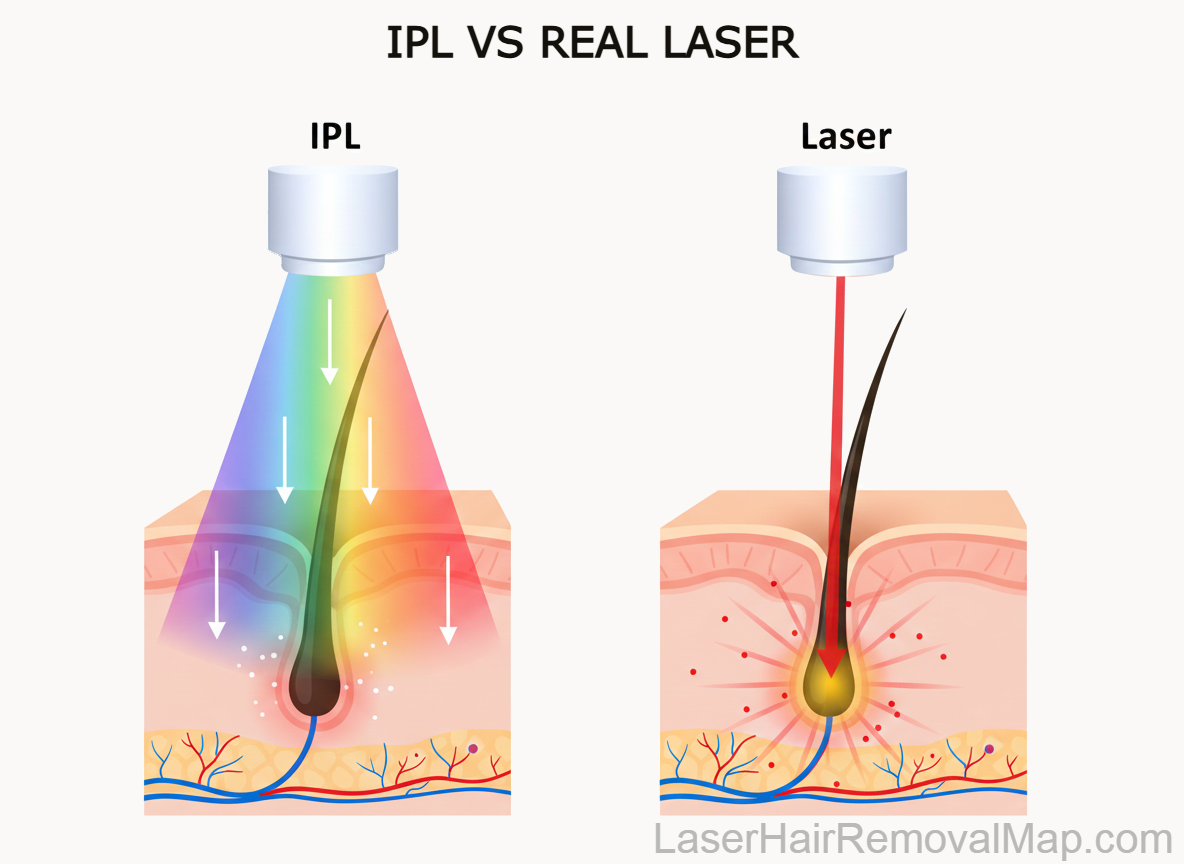
IPL emits multiple wavelengths (typically 500–1200nm) at once in a broad flash. The energy scatters across the skin rather than focusing on the follicle.
A real laser concentrates a single wavelength (e.g. 755nm or 810nm) into one beam that penetrates directly to the hair follicle. The energy is precise and consistent.
Why This Matters for Hair Removal
The difference isn't just technical. It affects your results.
IPL typically requires 8–12+ sessions compared to 6–8 for laser. Because IPL energy disperses, some follicles don't receive enough energy and survive. A head-to-head clinical trial comparing diode laser and IPL on the same patients found the laser was more effective at reducing hair. (Lasers in Medical Science, 2014)
Laser wavelengths can be chosen specifically for your skin type: 755nm for lighter skin, 1064nm for darker skin. IPL's broad spectrum makes it riskier for darker skin tones because the scattered light can be absorbed by skin pigment rather than hair pigment.
There's also the risk of paradoxical hypertrichosis, where treatment actually stimulates new hair growth instead of removing it. Studies have found this occurs in roughly 3% of patients, primarily on the face and neck. The risk is higher when energy levels are too low to destroy the follicle but enough to stimulate it. Because IPL scatters energy less precisely, some follicles may receive this "stimulating" dose rather than a destructive one. (American Journal of Clinical Dermatology, 2021)
Long-term, the gap widens. A systematic review found Alexandrite laser achieved 35–84% long-term hair reduction, Diode laser 32–69%, while IPL achieved only 27–52%. (Journal of Cosmetic and Laser Therapy, 2022)
IPL sessions are often cheaper upfront but you need more of them. When you factor in the total cost and time, laser frequently works out similar or cheaper in the long run.
Branded IPL You Might Not Recognize
These are all IPL technology, despite their marketing names:
- BBL (BroadBand Light)Sciton's premium IPL system
- AFT (Advanced Fluorescence Technology)Alma's enhanced IPL
- E-LightIPL combined with radiofrequency energy
- OPT (Optimal Pulse Technology)A pulse delivery method used in IPL machines
- DPL (Dynamic Pulse Light)Another marketing name for IPL
If your clinic uses any of these, you are receiving IPL treatment, not laser.
Is IPL Still Worth Considering?
IPL is a legitimate technology with real uses. It can reduce hair growth, and premium devices like Sciton BBL are well-engineered machines.
But the evidence gap is real. While long-term hair removal has been demonstrated for Alexandrite and Diode lasers, evidence for lasting results from IPL is still lacking. (Journal of the European Academy of Dermatology, 2006)
The equipment investment tells a story too. A clinical-grade laser like the Candela GentleMax Pro costs $80,000–$150,000. A quality IPL device costs $15,000–$30,000. Budget IPL machines can be found for as little as $2,000–$3,000. When a clinic charges significantly less than competitors, it's worth asking what equipment they invested in.
The issue isn't that IPL exists, it's that consumers deserve to know what technology is being used on their skin. If your clinic offers IPL and is transparent about it, that's fine. If they call it "laser hair removal", that's misleading.
What Real Users Say
Across forums and communities, a consistent pattern emerges. Users who tried IPL first and laser second overwhelmingly prefer laser for long-term results. Common themes include:
"IPL needed to be done every 2 months, and even after 1–2 years the frequency didn't change. Switched to laser and after 6–8 sessions, I only need treatments once per year."
"My tech told me IPL is a scam, and after you stop, any hair treated with IPL will grow back within weeks."
"Both work on the same principle but laser uses a much more precise wavelength, so more light is targeted at the hair, not the skin."
What to Ask Your Clinic
If you're unsure what your clinic uses, ask these two questions:
- "Do you use a laser or an IPL device?"
- "What is the specific brand and model?"
Once you have the answer, check if it's a real hair removal laser →