Home Lasers vs Clinical Lasers
Real lasers, real gap
Yes, They're Real Lasers
The home devices you can buy on Amazon from brands like DermRays, CurrentBody, and Epilaser are real diode lasers, not IPL. They use the same 808 to 810nm wavelength found in professional clinical devices like the Lumenis LightSheer and Cynosure Vectus.
The difference isn't whether they work. It's how much power they deliver, and the gap is larger than most people realize.
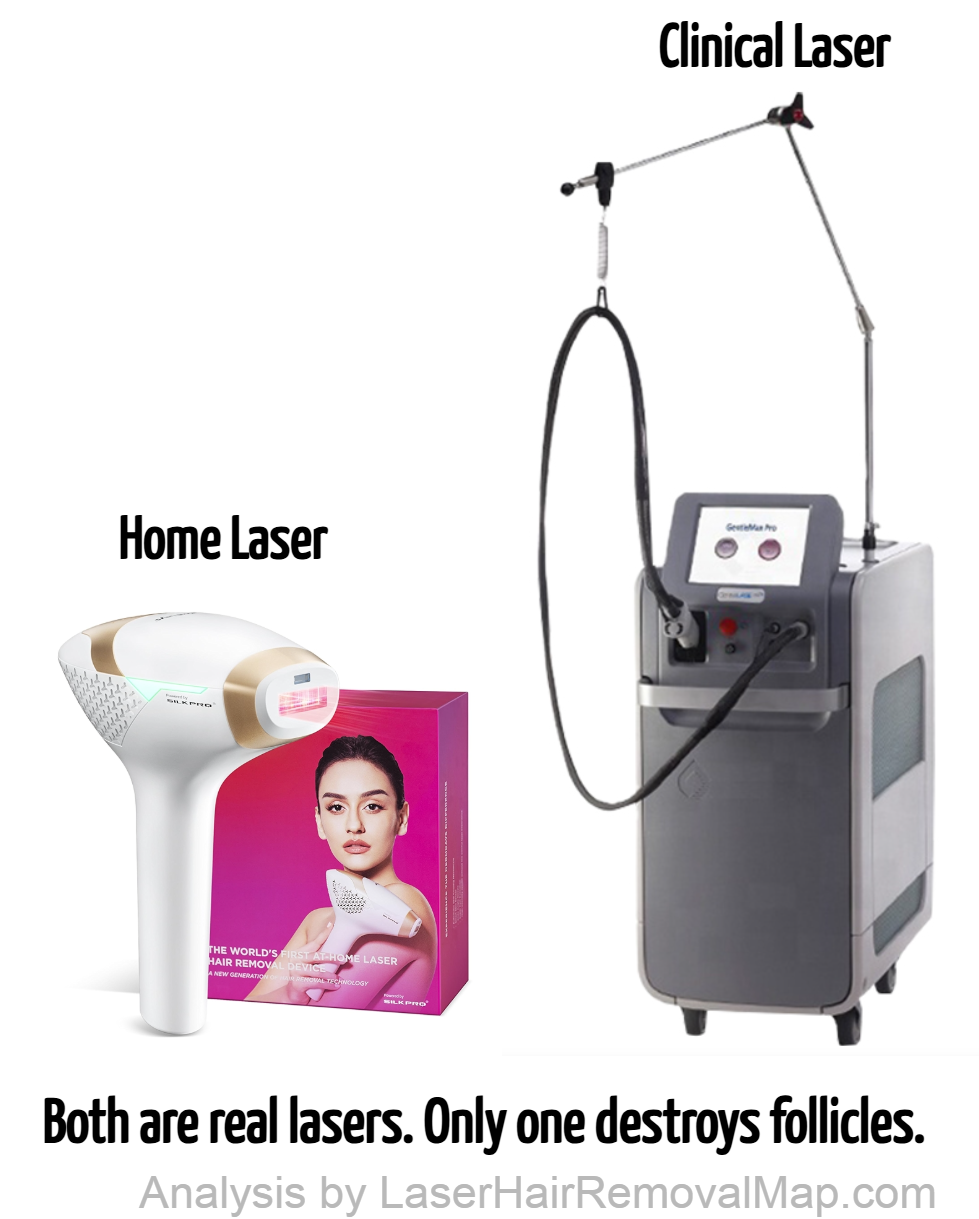
The Power Gap
The DermRays V8S is the most powerful home laser by total energy output: an 810nm diode laser with up to 9 J/cm² fluence and 27 joules per pulse across a 3 cm² treatment window. It's FDA-cleared (510(k) K230090) and available on Amazon for around $599.
In fluence (the energy concentration your skin actually experiences), the clinical device delivers 3 to 11 times more depending on the spot size and settings the practitioner selects. In total energy per pulse, the clinical device delivers about 3 times more across a similar spot area.
It's not just about energy. It's about power density. Destroying a hair follicle requires heating it to a specific temperature and sustaining that temperature long enough for the heat to conduct from the hair shaft to the surrounding germ cells. This depends on three factors working together: energy output, pulse duration, and spot size. Clinical devices are engineered to hit the right combination. Home devices fall short on all three.
What About the Epilaser?
The Epilaser Pro by Epilady (the company that invented the mechanical epilator in 1986) takes a fundamentally different approach. Instead of flooding the skin surface with light, a camera identifies individual follicles and four diode lasers target them one at a time.
It claims 24 J/cm² at each follicle, approaching clinical fluence levels. The technology is legitimate and has three generations of FDA clearance (2017, 2022, 2024).
However, all performance data (70% reduction in 3 months) comes from the manufacturer only. There are no independent clinical studies as of early 2026. We classify it as “Limited Results” until independent data is available.
Why the Gap Exists
The power gap isn't a design flaw. It's a legal requirement.
Professional lasers are Class IV medical devices: they can cause immediate tissue damage and require trained operators, protective eyewear, and controlled clinical environments. A clinic also needs dedicated 220V electrical service and often a water cooling system just to run one.
Home devices are classified for over-the-counter use. They must be safe enough for anyone to operate without training, in a bathroom, plugged into a regular outlet. That safety requirement caps their power output well below the threshold needed to permanently destroy a hair follicle in a single pulse.
FDA-cleared doesn't mean clinically equivalent. The FDA clearance on home devices confirms they are safe for unsupervised use. It does not mean they deliver the same results as the clinical lasers used by your provider.
What It Means for Your Results
Permanently destroying a hair follicle is not just about reaching a high enough temperature. The heat must be sustained long enough to conduct from the hair shaft outward to the germ cells that produce new hair. If the temperature drops too quickly, the follicle survives. This is why the most common reason hair removal fails is simply that the equipment cannot generate the required temperature for the correct duration.
Clinical lasers solve this with higher power output, calibrated pulse durations, larger spot sizes that penetrate deeper into the skin, and active cooling systems (chilled sapphire tips, cryogen spray, or forced cold air) that protect the skin surface while allowing more energy to reach the follicle. Home devices have none of these.
This is why home devices can slow regrowth and thin hair with consistent long-term use (typically 2-3 sessions per week over months), but don't achieve the permanent hair reduction that clinical lasers provide in 6-8 sessions spaced 6-8 weeks apart.
Home devices work best as maintenance between professional sessions, or for people who can't access or afford clinical treatment and accept slower, more limited results.
If your clinic uses a device you can buy on Amazon, that's worth knowing.
How We Classify Home Devices
We classify home devices separately in our equipment database with a “Limited Results” badge. This doesn't mean they're bad products. It means they operate under fundamentally different power constraints than the clinical devices your provider uses, and comparing them directly would be misleading.
Class IV medical devices. Require trained operators, controlled environments, and dedicated electrical service. Capable of permanent hair reduction in 6-8 sessions.
Examples:
Class II home devices. Safe for unsupervised use. Effective for hair thinning and maintenance. Limited evidence for permanent hair reduction.
Examples:
For more on how equipment cost and brand affect treatment quality, see our equipment cost analysis. To learn the difference between purpose-built and multi-purpose clinical lasers, see our purpose-built vs multi-purpose guide. To verify what equipment your clinic uses, try our equipment verification tool.
Have information about equipment we should investigate? Get in touch.